
Finding Meaning in the Midst of Forgetting
I didn’t need assistance with my stroke, but I did need a connection with my mom.

October 22, 2025
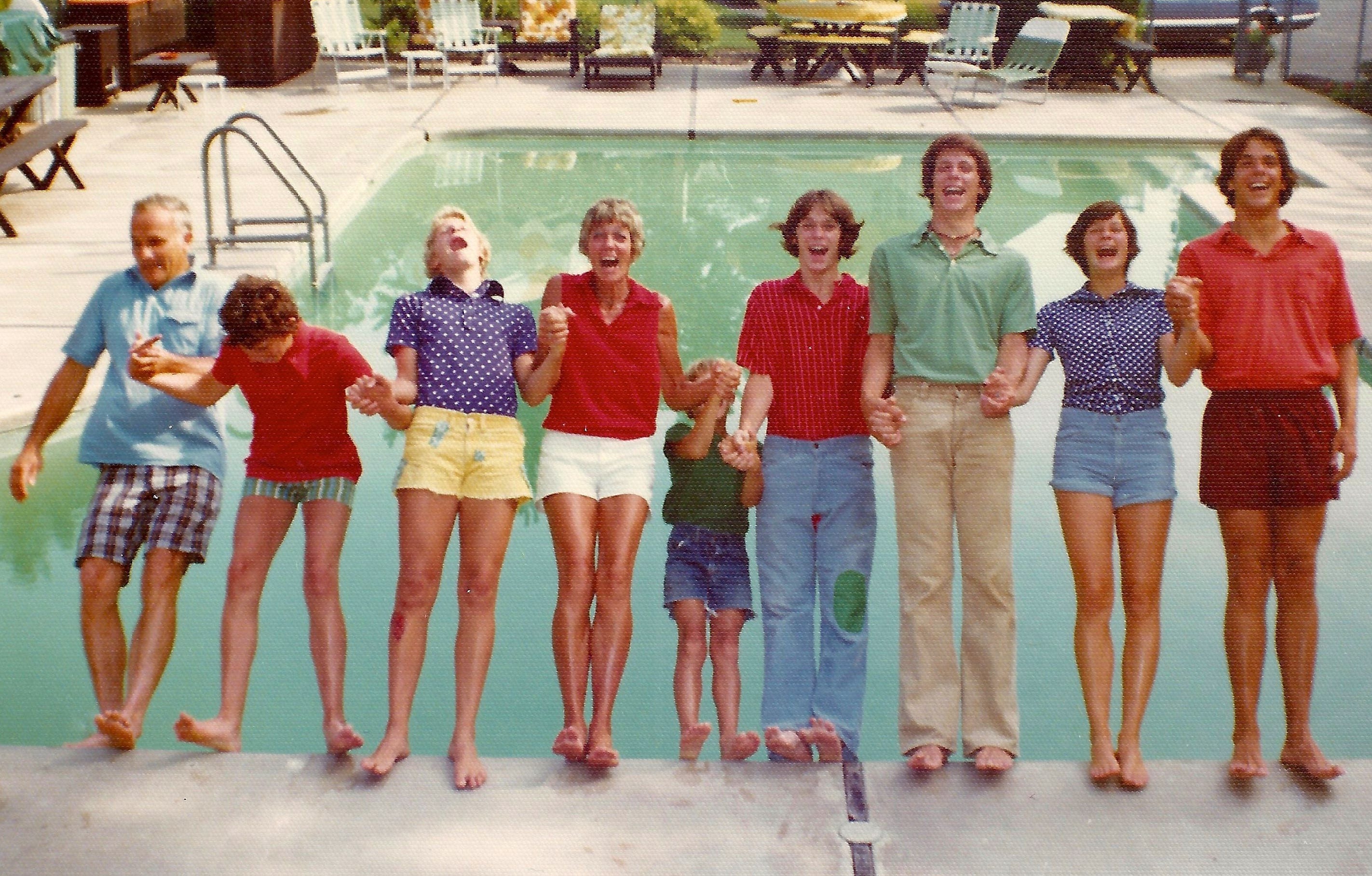
Recently, my siblings and our spouses had a vibrant text thread noting the 20th anniversary of our mom’s passing. Any memory of my mom is bittersweet. So much gratitude and so much sadness. While she lived to the age of 78, she spent most of her last 2 decades in a slow decline due to dementia. This began in the late 1980’s when our understanding of dementia and Alzheimer’s was far less comprehensive than it is today. All these years later, however, it was a delight to hear how each of us was honoring her.
Among her many gifts, she was a teacher at heart. She taught skiing, mostly to adults who had never been skiing. And she loved to teach swimming. The bittersweet part of it is our mom was an amazing and beloved swimming instructor, until she wasn’t.
She taught hundreds of kids each summer in our backyard pool, for over 30 years, until she couldn’t.
The sounds of summer at our childhood house included splashing water, a high-pitched whistle, and my mom’s ‘teacher voice’ bellowing over it all, hour after hour. Until it was quiet.
As a young mother with 4 little boys, my mom – ‘Sis’ to her friends and Mrs. Boyd to kids across our community – had read too many stories of kids drowning at a nearby lake during one of the first summers of my life.
“This doesn’t have to happen,” she said to any who would listen.
First at that lake, then at a friend’s pool, and finally in a pool my parents had built in their backyard, she devoted her summers to teaching swimming to kids of all ages, and even adults. She loved the transformation that took place on children. She reveled in the confidence kids demonstrated with each level of success. She was revered and widely known in our community. Even today, I occasionally run into adults who remember her fondly from their youth.
A few years before she gave up teaching for good, friends and family began to notice my mom’s memory slipping. It appeared in all areas of her life; this forgetting of names, appointments, and simple tasks in the kitchen.
When confronted with dementia in someone you love, you learn that the first thing to go is short term memory, while the brain holds on to long term memories until the very end.
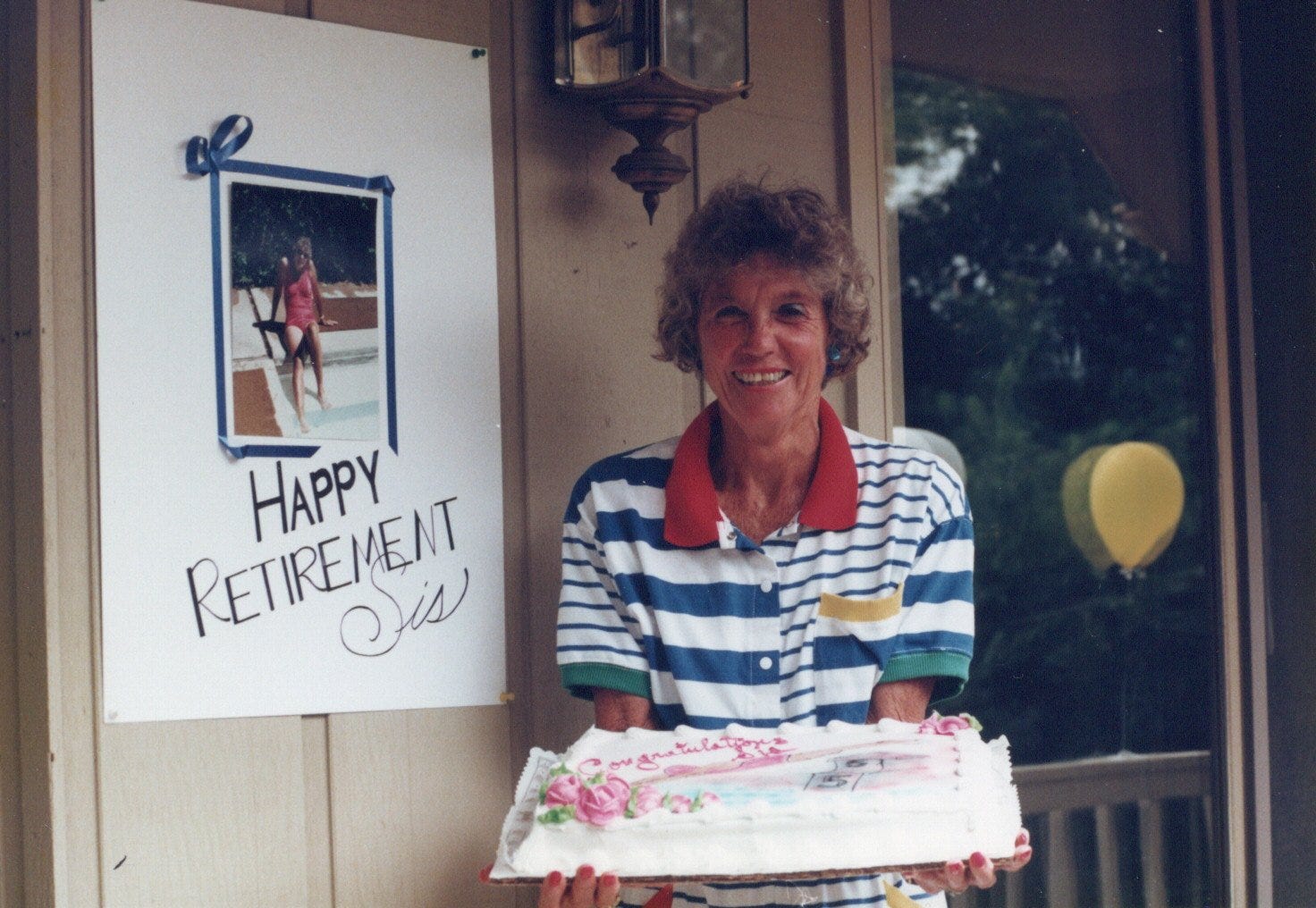
Because swimming was something she had done for so long, and was so core to her being, her ‘village’ of loved ones helped make it possible for her teaching. They did the administrative and financial tasks, while she focused on actual instruction. For a couple of years, it worked well for everyone. And yet, eventually, and with great tenderness, the decision was made to forgo a new summer of classes and instead host a retirement party to celebrate her lifelong commitment. We wanted to hold it while she could still feel the love, admiration, and gratitude of former students and parents. Most who came to our party were now adults. It was a lovely evening. It didn’t matter that mom didn’t always know who was thanking her. She relished the connections as she always had.
But, with each passing month and year, it became harder and harder to stay connected to mom. Her failing memory, our busy family life, and distance made it hard. Conversation was increasingly stilted and phone calls simply didn’t work. When she and dad did come to visit, she loved to sit with her grand kids while Tammy read children’s books to them all. She didn’t appear to follow the story lines, but we knew she relished the tactile experience of sitting with children, laughing with a friendly woman, and feeling loved and safe.
This woman who had always loved children was becoming like a child again.
One summer vacation, we met mom and dad at a public pool in Red Wing, MN. Our young kids loved the cool water on a hot summer day. Mom, on the other hand, was clearly feeling lost amidst the many people, noises, and general chaos of the setting. She didn’t want to swim, and quickly became restless and disoriented. My sadness at her sense of disconnect unleashed a well of grief within me. Not sure what else to do, I began swimming laps in an adult lane. With my face in the water, my tears of lament and anger would not be seen.
With compassion and wisdom, Tammy asked mom if she might watch the two of us swim and give us some pointers. Help us improve our strokes. Which she did.
Within seconds, she was pacing along the edge of the pool, almost hovering over us. “Stroke, breath, rotate, breath, stroke…” Gone was her inaudible mumbling and fear. “Stroke, breath, turn your head, yes!” With clarity and precision, she was back teaching swimming. “Put your face in, turn your head, that’s it! Yes!”
I didn’t need assistance with my stroke, but I did need a connection with my mom. I wanted to connect as a 35 year old son and father of three. That didn’t happen. But as the sun set low in the sky on a beautiful summer evening, I was once again her 12 year old son. I was not the son she had taught swimming decades earlier; I was the 12 year son she was teaching right then and there.
It wasn’t what I had expected that day, but there was deep joy (and some grief). I didn’t know then, nor do I know today, if it was a past tense experience or a present tense experience. Or both. I wasn’t being seen for who I was in that moment of my life, but I was being seen in the way she could see. All the gratitude I had known as a child to have a mom who knew me, and saw me, came flooding back in.
That unexpected gift had real meaning, shaped as it was in mystery the way dementia muddles our knowing.
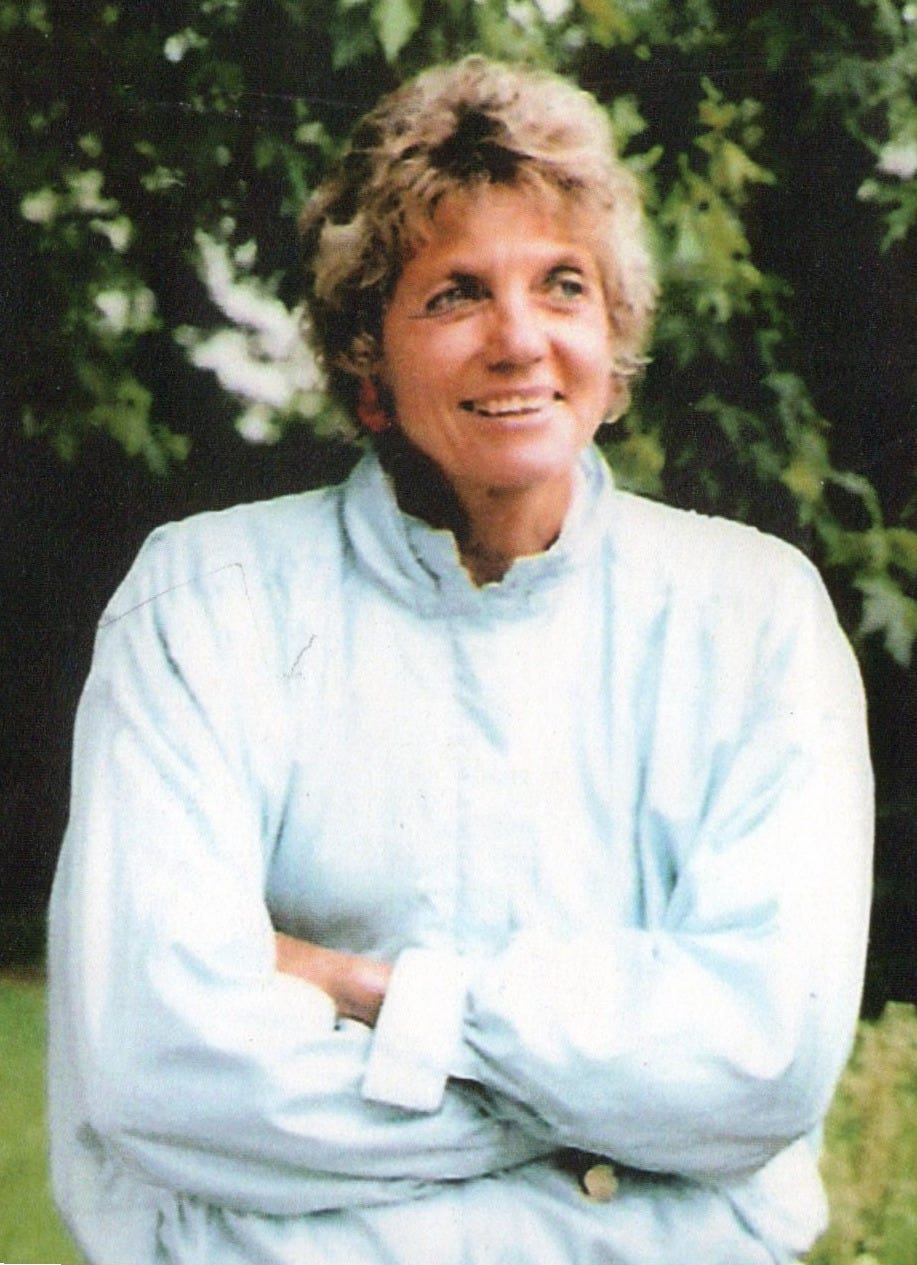
I share these stories, in part, to honor our mom. But I know that almost all of us love someone who is either losing their memory, or has lost it. I know that many of us struggle with the question of what ‘tense’ are we living in with those people. I write because I have come to realize there is a wide and broad community of those who love someone with Alzheimer’s. We live with the paradox of grief and transformation. We grieve what can no longer be remembered, discussed or enjoyed; while at the same time our understanding of love, care giving, human connection, and soulfulness have been expanded in ways we could not have imagined.
Has there been someone in your life that lived with dementia?
What did you learn from that journey with them? Are you willing to share?
What an exquisite love letter to your mom, Wint. Just lovely.
So beautiful❣️ 💕💔💓💗 Thank you, Wint❣️